Dead biofilm
is still biofilm.

Biocides kill the bacteria and leave everything they built stuck to the surface. Dehesion makes the whole biofilm let go.

Biocides kill, but the biofilm stays

They struggle to get through the biofilm matrix, and the cells they do kill stay stuck to the surface.

Flushing fails to wash it away

Even at high pressure, the biofilm holds on to the surface.

And it grows back

The dead biofilm stays where it was, and new cells grow back over it.

So we stopped trying to kill it.

Dehesion penetrates the biofilm

It gets through the matrix that keeps biocides out.

The biofilm is re-architected

Nothing is killed. Its architecture loosens, so it no longer holds on to the surface.

Then it washes away

A normal rinse carries it off the surface.

  • Living cell
  • Dead cell
  • Matrix
  • Biocide
  • Dehesion
  • Water flow

Where it could work first

Biofilm grows wherever water stays in contact with a surface. We are starting with two places where that is expensive.

  • Coolant
  • Heat
  • Dehesion

Data-centre cooling loops

Cooling water is warm, it recirculates and it carries nutrients, which is what biofilm likes. A film on a heat-exchange surface insulates it, so pumps and chillers work harder to move the same heat. As racks move to liquid cooling, the channels get narrower and less forgiving.

Releasing the biofilm in place, without taking the loop down for a chemical clean.
  • Water
  • Salt
  • Dehesion

Reverse-osmosis membranes

Biofilm on a membrane blocks the path the water has to take. Plants stop lines to clean them, and repeated chemical cleaning wears the membrane out.

A clean that lifts the biofilm off the membrane instead of attacking it.

Another surface?

If biofilm keeps coming back on your heat exchangers, pipework or process lines, we would like to hear about it.

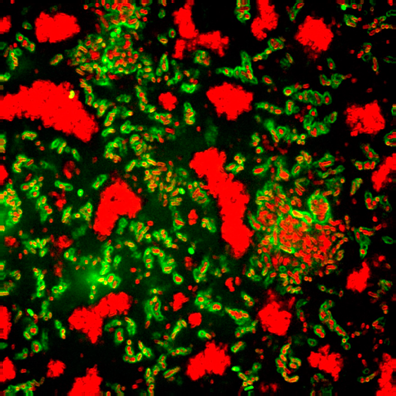
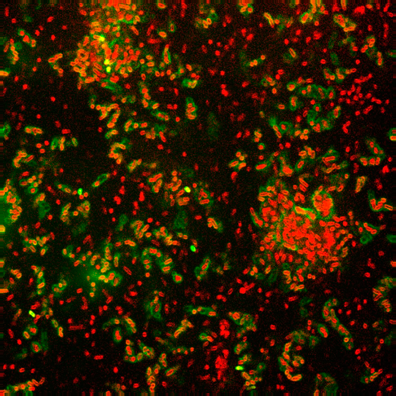
Confocal image of the biofilm after a wash, with far fewer cells left Confocal image of the biofilm before a wash: dense red groups of cells between green matrix Before the wash After
A Vibrio cholerae biofilm before and after a wash. Cells are red, matrix polysaccharide is green. Adapted from Moreau et al., Nat. Commun. (2025), CC BY 4.0.

Built on published research

Dehesion comes from research into how biofilms hold together, and how they come apart.

In work published in Nature Communications, Alexis and colleagues showed that the cells in a biofilm can switch from being held by their matrix to being pushed out of it. When that happens, the biofilm comes apart and a wash carries the cells away. Dehesion is built to trigger that switch on demand.

The next step is pilots on working equipment, and we are looking for partners to run them with.

Who we are

Dr Alexis Moreau

Dr Alexis Moreau

CEO

Postdoc
Yale University
PhD
Physics and materials science, Marseille
Master’s
Princeton / Harvard University
Dr Georgeos Hardo

Dr Georgeos Hardo

CTO

PhD
University of Cambridge
Master’s
University of Cambridge

Have a surface that won’t stay clean?

We are looking for pilot partners in data-centre cooling and water treatment. Tell us what you are dealing with.